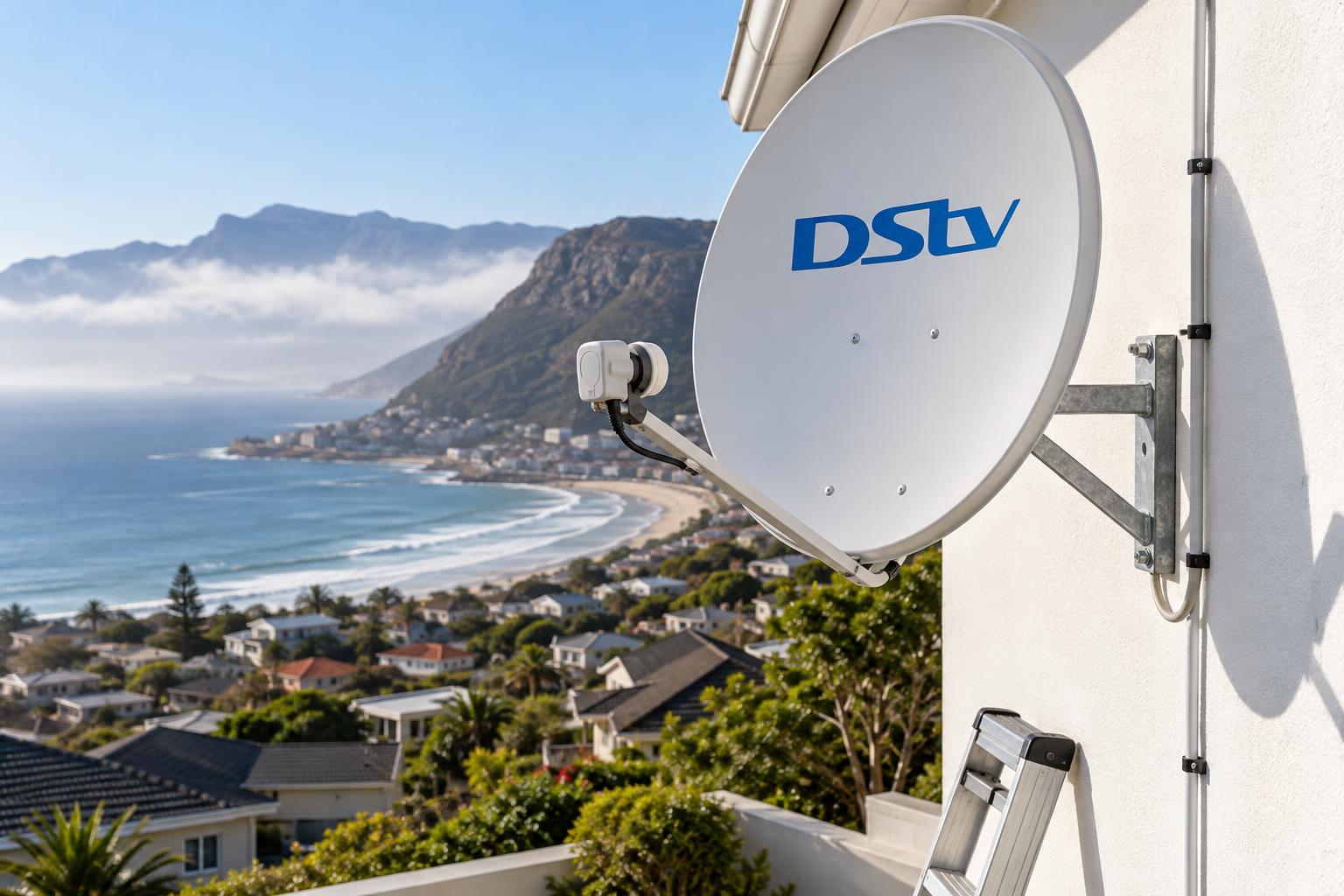
Quick answer: Salt air DStv dish corrosion starts at the small metal parts, not the dish face. Rusty brackets, bolts, LNB connectors and cable joins let water in and weaken the signal until the picture breaks up. You stop it with a galvanised or stainless bracket, sealed connections, good cable and a quick check twice a year.
Living a few streets from False Bay is wonderful for you and hard on your satellite gear. Salt mist settles on every bolt, plug and bracket on your roof, every single day. This guide explains how salt air DStv dish corrosion works, how to spot it early, what it takes to fix it, and how we build installs that last on this coast.
Key points before you read on
- Salt air DStv dish corrosion does most of its damage at joins: the bracket, the bolts, the LNB and the cable connectors.
- Rust rarely kills the signal in one day. It weakens it slowly until wind or rain tips it over.
- A rusted bracket also lets the dish move, so corrosion and alignment problems often arrive together.
- Galvanised or stainless brackets, sealed connectors and UV resistant cable make the biggest difference.
- A five minute look from the ground every six months catches most problems early.
A typical Fish Hoek story of salt air DStv dish corrosion
Picture a holiday home on the slope above Glencairn. It stood closed for most of winter. The owners arrive for the first long weekend of spring, switch on the TV and the picture freezes, breaks into blocks, then shows no signal.
Nothing obvious has happened. No storm ripped the dish off the wall. The dish is still there, pointing roughly the right way.
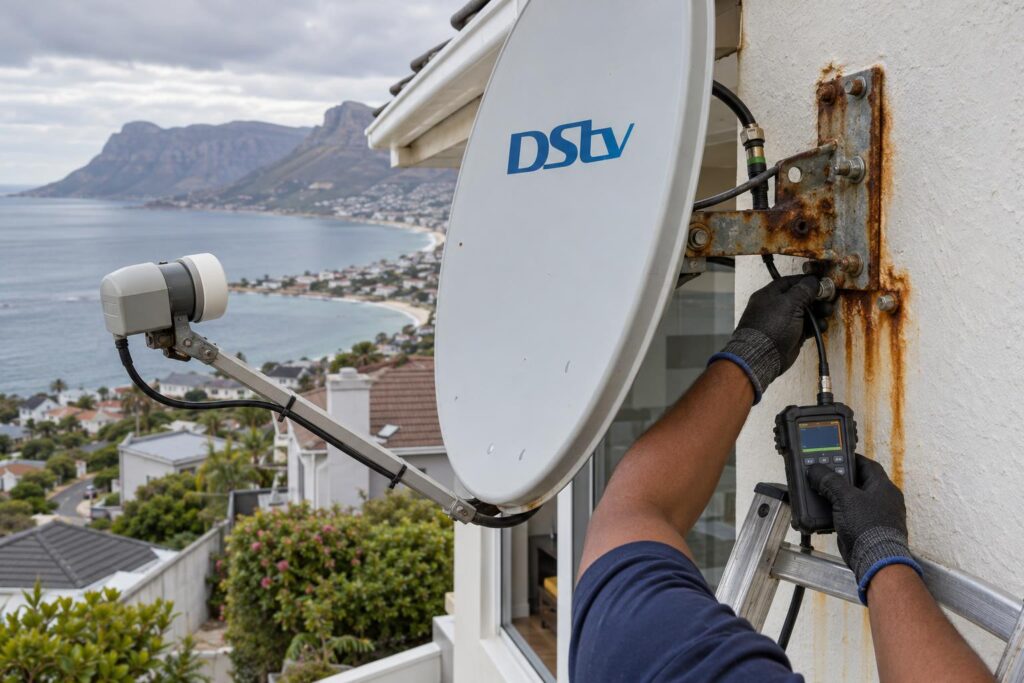
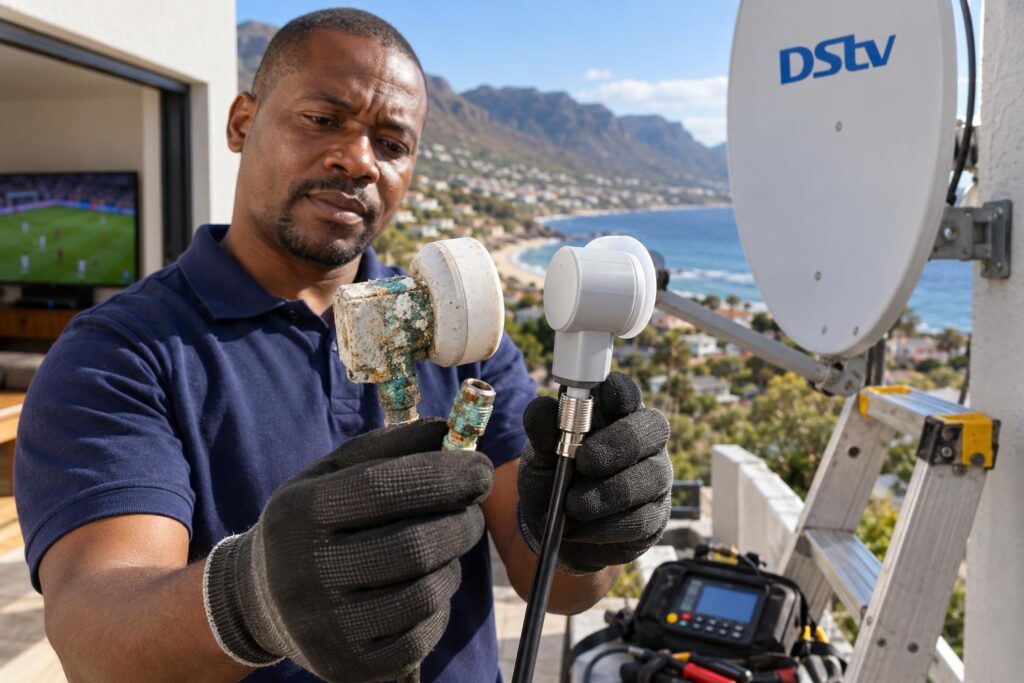
Up on the ladder the real story is clear. The bolts on the wall bracket have turned orange and are streaking rust down the paint. The cable plug at the LNB is green and crusty inside. The arm has a slight wobble that was not there last summer.
This is how salt air DStv dish corrosion usually looks in the Far South. It builds quietly for months, then one wet, windy week finishes the job. We see the same pattern in seafront flats in Fish Hoek, cottages above Kalk Bay and homes near the beach in Simon's Town.
The good news is that it is easy to prevent and usually simple to fix. It is the reason our local DStv installers in Fish Hoek treat every coastal job as a salt job first.
If you own a place that stands empty for weeks at a time, our holiday home DStv checklist covers the other things to check before guests arrive.
How salt air DStv dish corrosion actually happens
Sea spray breaks into tiny droplets that the wind carries inland. Those droplets dry on metal and leave a fine film of salt behind.
Salt pulls moisture out of the air. So even on a dry day, a salty bolt stays slightly damp. Damp metal plus salt is exactly what rust needs, and that is where salt air DStv dish corrosion begins.
Why False Bay is harder on metal than inland suburbs
Homes in Sun Valley, Sunnydale and Noordhoek still get salt, but the ones closest to the water get it hardest. Homes along Main Road in Fish Hoek, Clovelly and the Glencairn and Simon's Town seafront take sea mist almost daily.
The southeaster makes salt air DStv dish corrosion worse. It drives salty air up the valley and into every gap in a connector. Winter rain then soaks in, and the cycle starts again.
The parts that rust first
- Bracket and bolts: ordinary zinc plated hardware rusts within a season or two on this coast.
- Cable connectors: the small screw-on plug at the LNB is the weakest point if it is not sealed.
- The LNB itself: sun makes the plastic housing brittle, then salty water gets inside.
- Cable: cheap cable cracks in the sun, and water travels down the copper core.
- Mixed metals: a stainless bolt pushed through a plain steel bracket can make the steel rust faster around the hole.
The LNB matters even more on modern setups. Explora and most XtraView systems need a Smart LNB, so a corroded one takes every linked decoder off air at once. Our Smart LNB price guide explains when a replacement is worth it.
Signs of DStv dish rust you can spot early
You do not need to climb onto the roof to spot early salt air DStv dish corrosion. A pair of eyes in the garden and a look at your decoder will tell you plenty.
What you can see outside
- Orange or brown streaks running down the wall below the bracket.
- White powder or green crust around the bolts or the cable plug.
- Paint lifting or bubbling on the dish arm or the dish rim.
- The dish moving or shaking more than usual in wind.
- Cable that looks cracked, faded or hangs loose from the clips.
What you notice on the TV
Salt air DStv dish corrosion shows up on screen as pictures that freeze or break into blocks, mostly in rain or wind. Some channels may drop out while others still work. The E48-32 no signal message starts appearing more often and clears by itself later.
Check the signal quality on your decoder's signal screen. If it reads lower than it used to on a clear day, something between the dish and the decoder is losing signal.
A loose or damaged lead indoors can cause the same symptoms. Before blaming the dish, read our guide to DStv decoder cables and connections and rule out the cables behind the TV.
Can you fix a rusted DStv dish, or should you replace it?
The right fix for salt air DStv dish corrosion depends on where the rust is and how far it has gone. Most of the time we do not need to replace the whole dish.
Clean and re-seal
If the rust is only on the surface of a bolt or the outside of a connector, we clean it, replace the plug and seal the join properly. That is often enough to bring the signal back to full strength.
Replace the LNB, connectors or bracket
When rust has eaten into the connector threads or the bracket, we replace those parts. A rotten bracket must go, because it will let the dish drift out of line in the next southeaster. Our dish installation and alignment service includes refitting on a marine grade bracket and peaking the signal with a meter.
Start again with a full re-install
Sometimes the dish face is pitted, the arm is weak and the cable is cracked from roof to lounge. Patching that up only buys you a few months. A proper new DStv installation with fresh, salt resistant parts is the better value in that case.
Wondering about the cost of a dish? Our guide on what a new DStv dish costs walks through what affects the price. We always quote after we have seen the job, so you know exactly what is included.
| What we find | Usual fix | What it prevents |
|---|---|---|
| Light surface rust on bolts | Clean, replace bolts with stainless, seal | Rust spreading into the bracket |
| Green or white crust in the connector | New connector, sealed with self-amalgamating tape | Water travelling down the cable |
| Cracked or brittle LNB | Replace LNB, then re-align | Signal loss in rain |
| Rotten or loose bracket | New galvanised or stainless bracket and re-align | Dish drifting in the wind |
| Pitted dish, weak arm and cracked cable | Full re-install | Repeat call-outs |
Rust on your dish or a signal that keeps dropping?
Send us a photo of the dish and bracket on WhatsApp. We will tell you if it needs a clean, a part or a new setup before we come out.
Call 079 754 5527WhatsApp usBook onlineStopping salt air DStv dish corrosion before it starts
Preventing salt air DStv dish corrosion costs very little compared with a repair visit. These are the things we do on every coastal job.
Choose the right bracket and fixings
We use galvanised or stainless brackets with stainless bolts and wall plugs. Plain zinc plated hardware looks the same on day one, but it stains your wall and loosens within a couple of seasons.
The bracket goes into solid brick or a rafter, never only into a fascia board. A firm mount means the wind cannot work the bolts loose and open them to salt.
Seal every connection
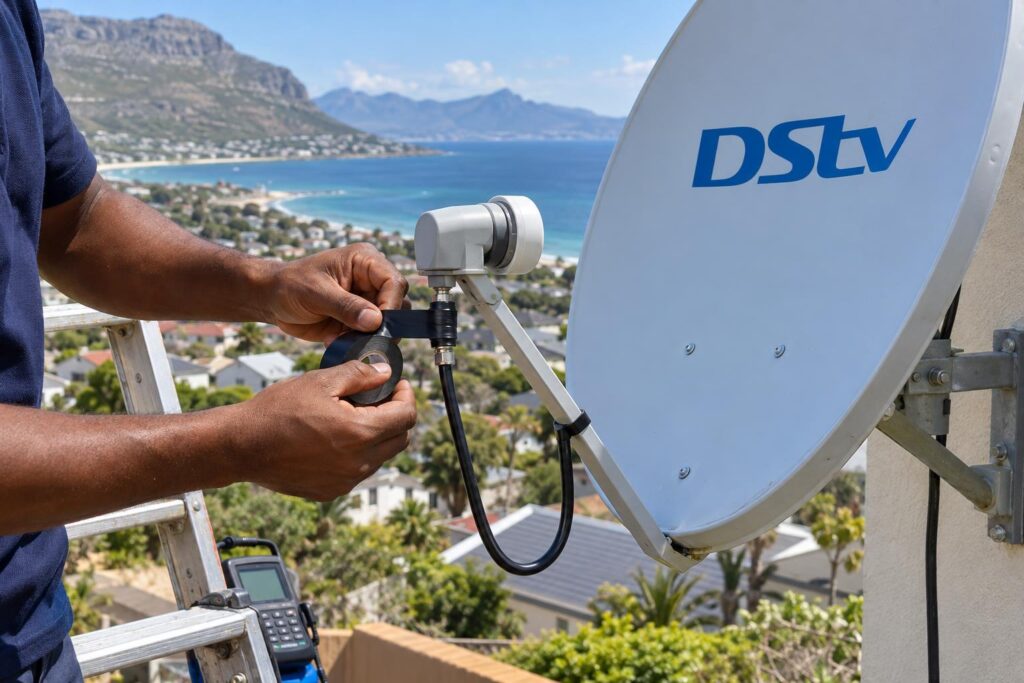
Each screw-on connector is fitted tightly, then wrapped with self-amalgamating tape. That tape fuses into a waterproof sleeve that keeps salt and rain out of the threads.
We also leave a small drip loop in the cable below each join. Water then runs off the bottom of the loop instead of into the plug.
Use cable and parts built for the coast
We run good quality RG6 cable with a UV resistant outer jacket and clip it neatly along the wall. Cheap cable is a false saving here, because once water reaches the copper the whole run must be replaced.
Local tip: If you have a choice of walls, put the dish on the side facing away from the sea, as long as it still has a clear view of the satellite. Even a little shelter from direct spray slows rust down noticeably.
These habits are the backbone of every DStv installation in Fish Hoek we do, from Capri to the houses along Kommetjie road.
The same solid mounting also helps the dish hold its line in strong wind. Our article on southeaster dish alignment myths covers that in more detail.
Can you paint a DStv dish near the sea?
This is one of the most common questions we get. The short answer is yes, carefully.
A light coat of ordinary non-metallic paint on the rim, arm and bracket is fine and can slow rust. Avoid metallic paints, which can interfere with the signal.
Keep the coat thin on the dish face. Thick layers of paint can affect how the face reflects the signal. Never paint the LNB, the cable plugs or the face of the LNB cover.
Paint is a cover for small chips, not a cure for salt air DStv dish corrosion. If rust has already eaten through the bracket or arm, the part needs replacing.
Your salt air DStv dish corrosion checklist
Do this twice a year to catch salt air DStv dish corrosion early: once after winter, and once before the summer southeaster season. It takes about five minutes from the ground.
- Stand where you can see the dish clearly and look for orange streaks on the wall below the bracket.
- Look at the bolts and the arm for bubbling paint, white powder or green crust.
- Check that the cable runs neatly in its clips and has no cracks or loose loops.
- Watch the dish on a windy day. It should not shake or nod.
- On a clear day, open the signal screen on your decoder and note the signal quality reading.
- Compare the reading with the one you noted last time. A clear drop means something needs attention.
- Rinse the dish and bracket gently with fresh water from a hose if you can reach it safely from the ground.
If your account shows an error and you want to clear it yourself, the DStv help and self service page lists the official app, WhatsApp and USSD options.
Never climb onto a wet or windy roof to check a dish. If something looks wrong, a photo from the ground is all we need to start.
Want an install that stands up to False Bay?
We fit marine grade brackets, sealed connectors and coastal cable as standard across Fish Hoek and the South Peninsula.
Call 079 754 5527WhatsApp usBook onlineSalt air DStv dish corrosion FAQs
How do I stop salt air DStv dish corrosion?
Use a galvanised or stainless bracket with stainless bolts, and seal every cable connector with self-amalgamating tape. Run UV resistant RG6 cable with a drip loop below each join. Then check the dish from the ground twice a year and rinse it with fresh water if you can do so safely.
Does a rusted DStv dish affect the signal?
Yes. Rust on the connectors and LNB lets water in and weakens the signal, so the picture breaks up in rain or wind. A rusted bracket also lets the dish drift out of line, which can bring up the E48-32 no signal message.
Can I paint my DStv dish?
You can paint the rim, arm and bracket with a light coat of non-metallic paint. Keep paint thin on the dish face and never paint the LNB or the cable plugs. If rust has eaten through a part, it needs replacing, not painting.
How often should a DStv dish near the sea be checked?
We suggest a quick look from the ground twice a year, after winter and before the summer southeaster. Homes right on the seafront in Fish Hoek, Glencairn or Simon's Town benefit from a professional check every year or two.
Do I need a new dish if mine has salt air DStv dish corrosion?
Not always. Most cases only need new connectors, bolts, a bracket or an LNB. We only recommend a full re-install when the dish face, arm and cable are all badly damaged.
Why does my DStv dish rust when my neighbour's does not?
It usually comes down to the hardware and how it was fitted. Zinc plated bolts and unsealed connectors rust quickly, while galvanised or stainless parts with sealed joins last for years. Which side of the house faces the sea also makes a difference.