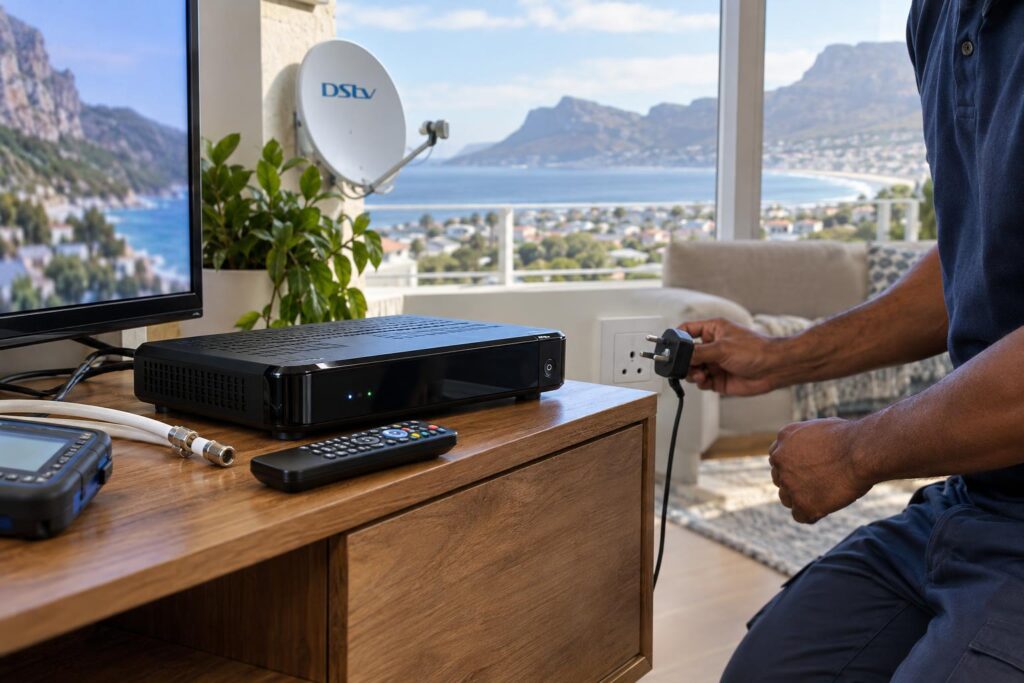
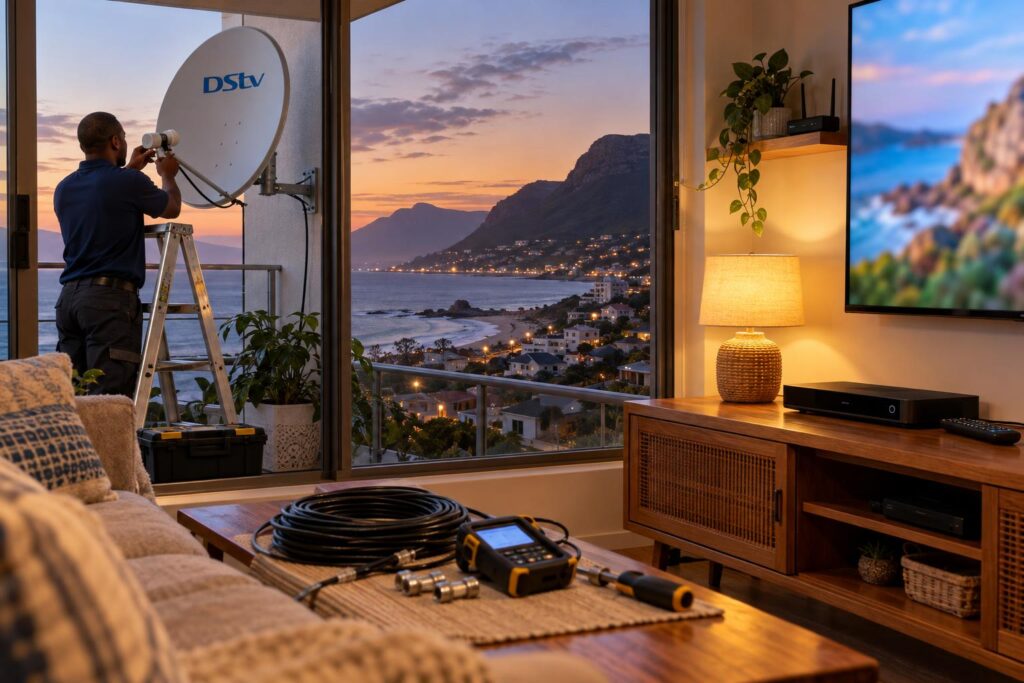
A signal finder for DStv measures how much satellite energy is reaching your dish and, on better models, how clean that energy is. It doesn't measure your picture, your subscription or your WiFi. In Fish Hoek, where the south-easter and salt air test every dish, knowing the difference stops you chasing the wrong fix.
Quick answer: A basic signal finder for DStv measures raw signal power, so it beeps louder as the dish points closer to any satellite. It can't tell which satellite it found, or whether the signal is clean enough to watch. Better meters identify Intelsat 20 and show signal quality. Your decoder's signal screen shows strength and quality too.
What a basic signal finder for DStv picks up
The cheap meters you see in hardware shops sit on the cable between the dish and the decoder. The decoder sends a small current up that cable to power the LNB, the unit on the arm in front of the dish, and the meter borrows a little of it to run. Our Smart LNB price guide explains the newer LNB that Explora decoders need.
What the meter reads is total power coming down from the LNB. Point the dish at a busy patch of sky and the needle rises. Point it at empty sky or a wall and it falls. That's all it knows.
The catch is that the sky over the Cape holds many satellites. A basic meter beeps just as happily for the wrong one as for Intelsat 20 at 68.5 degrees East, which is where DStv broadcasts from.
Strength is not the same as signal quality
Signal strength is the amount of signal arriving. Signal quality is how clean and usable it is once noise and interference are stripped out. You can have plenty of the first and very little of the second.
Think of a radio station on a stormy night. It's loud, but there's crackle on every word. A decoder needs the words, not the volume, so quality decides whether your rugby freezes.
Why the needle on a DStv signal tester can fool you
A strong reading with poor quality usually means something is spoiling the signal between sky and decoder. On the False Bay side, corroded connectors are the usual suspect, because salt creeps into the threads and adds noise without cutting the power much.
A cheap needle can't see that noise. A proper DStv signal tester can, which is why two meters on the same dish can tell different stories. Finding that hidden noise is a big part of our DStv signal repairs.
What each tool really measures
| Tool | What it measures | What it misses |
|---|---|---|
| Phone satellite app | Nothing from the satellite. It works out direction from GPS and the phone's compass | Any actual signal, plus compass errors near steel |
| Basic beeping meter | Total power reaching the LNB | Which satellite, and how clean the signal is |
| Digital meter with satellite ID | Which satellite is locked, plus strength and quality | Little, if used by someone trained |
| Your decoder's signal screen | Strength and quality of the DStv signal it receives | Which way the dish needs to move |
The surprise for most people is the first row. A phone app is a pointing aid, not a measuring tool.
Things no signal finder for DStv can measure
A meter only sees what happens between the satellite and the cable. Plenty of faults that look like signal problems sit somewhere else entirely:
- An E16 error, which is about the service being authorised on your decoder, not the dish
- Smartcard errors such as E51, where the decoder can't read the card
- A loose HDMI lead between the decoder and the TV
- Slow internet on Catch Up or streaming apps
If your screen shows E48-32 on the other hand, no signal is reaching the decoder at all. Our page on the E48-32 error and its causes covers the simple checks for that one.
Need a hand in Fish Hoek?
Tell us what you need or what your screen shows. We give you a clear price before we drive out.
Call 079 754 5527WhatsApp usBook onlineWhat the readings tell us on Fish Hoek dishes
When our technicians test a dish in Fish Hoek, the pattern of readings usually points straight at the cause. Strong power with weak quality on a sea-facing flat in Clovelly often means salty connectors. Our guide to salt air dish corrosion explains how to slow that down.
Readings that swing while the wind blows point to a bracket that has worked loose. Homes on the slopes of Sun Valley and Capri cop the full south-easter, and a dish can creep off its aim over a single summer. We bust some common myths about that in our southeaster dish alignment post.
In sectional title complexes, a reading at your wall plate reflects a shared system on the roof. If every unit in a Sunnydale or Glencairn block drops at once, the fault is on the communal dish, which falls under our communal DStv installation work.
How to check DStv signal strength without leaving the lounge
You can see the same two numbers we look at, strength and quality, on your own decoder. Here's how to check DStv signal strength safely:
- With live TV playing, press the menu button and go into settings.
- Open the signal or satellite information screen.
- Read both bars and note them down, with the weather at the time.
- Repeat on a calm, dry day so you have something to compare against.
A sudden drop in quality, when the weather hasn't changed, is the clearest clue that something at the dish needs attention.
Safety first: Don't take a meter up a ladder to check for yourself. Wind off the bay can knock you off balance, and dishes on older Fish Hoek homes often sit on steep, tiled roofs. Read the decoder screen indoors and leave the dish to a technician.
How our technicians use a signal finder for DStv
We connect a proper meter at the dish, confirm it has locked on to Intelsat 20, and peak the dish for the best quality, not just the loudest power. Then we tighten the bracket and check the reading hasn't shifted.
Before we leave, we read your decoder's screen with you so you know your baseline. That's the core of our dish installation and alignment service, and it's how we quote and test for homes across Kalk Bay and Noordhoek too.
Technician tip: If you run an Explora on a Smart LNB, each tuner gets its own feed. One weak tuner can cause odd recording failures while live TV looks fine, so mention it when you book.
Get your signal tested in Fish Hoek
If your readings look poor or keep changing, the dish needs a meter that sees quality as well as power. Our local team offers DStv installation in Fish Hoek and the South Peninsula, and we always quote first. If the checks above don't sort it out, call a technician: book a signal test and we'll show you the readings before we go.
Talk to our Fish Hoek team
We work across Fish Hoek, Clovelly, Sun Valley, Kalk Bay, Sunnydale and nearby. Call or WhatsApp us and we will tell you the practical next step.
Call 079 754 5527WhatsApp usBook onlineSignal finder for DStv: FAQs
How does a signal finder for DStv work?
A basic one sits on the cable between the dish and the decoder and measures the total signal power coming from the LNB. It beeps or the needle rises as the dish points closer to a satellite. It can't tell which satellite it is, so a trained eye or a better meter is needed to confirm.
Does a DStv signal finder tell me which satellite I'm on?
A cheap analogue one doesn't. It responds to any satellite, which is how dishes end up pointed at the wrong one. Digital meters with satellite identification show the satellite name, and that's what our technicians use to confirm the dish is locked on Intelsat 20.
What should DStv signal strength be?
Decoders show the scale differently, so there's no single target number. Signal quality is the reading to watch, and the best comparison is your own decoder on a clear day. If quality drops sharply while the weather is fine, the dish, cable or LNB needs checking.
Can salt air in Fish Hoek affect my signal readings?
Yes. Salt gets into connectors and the LNB, adding noise to the signal. Often the strength still looks fine while quality falls, which is why a cheap meter can miss it. Weatherproofed connectors and a check every so often help sea-facing homes.
Will a signal finder work on the communal dish in my complex?
It can be used on the roof by whoever maintains the shared system, but a meter at your wall plate only shows what the communal setup delivers to your flat. If neighbours have the same problem, report it to the body corporate so the shared system gets checked.