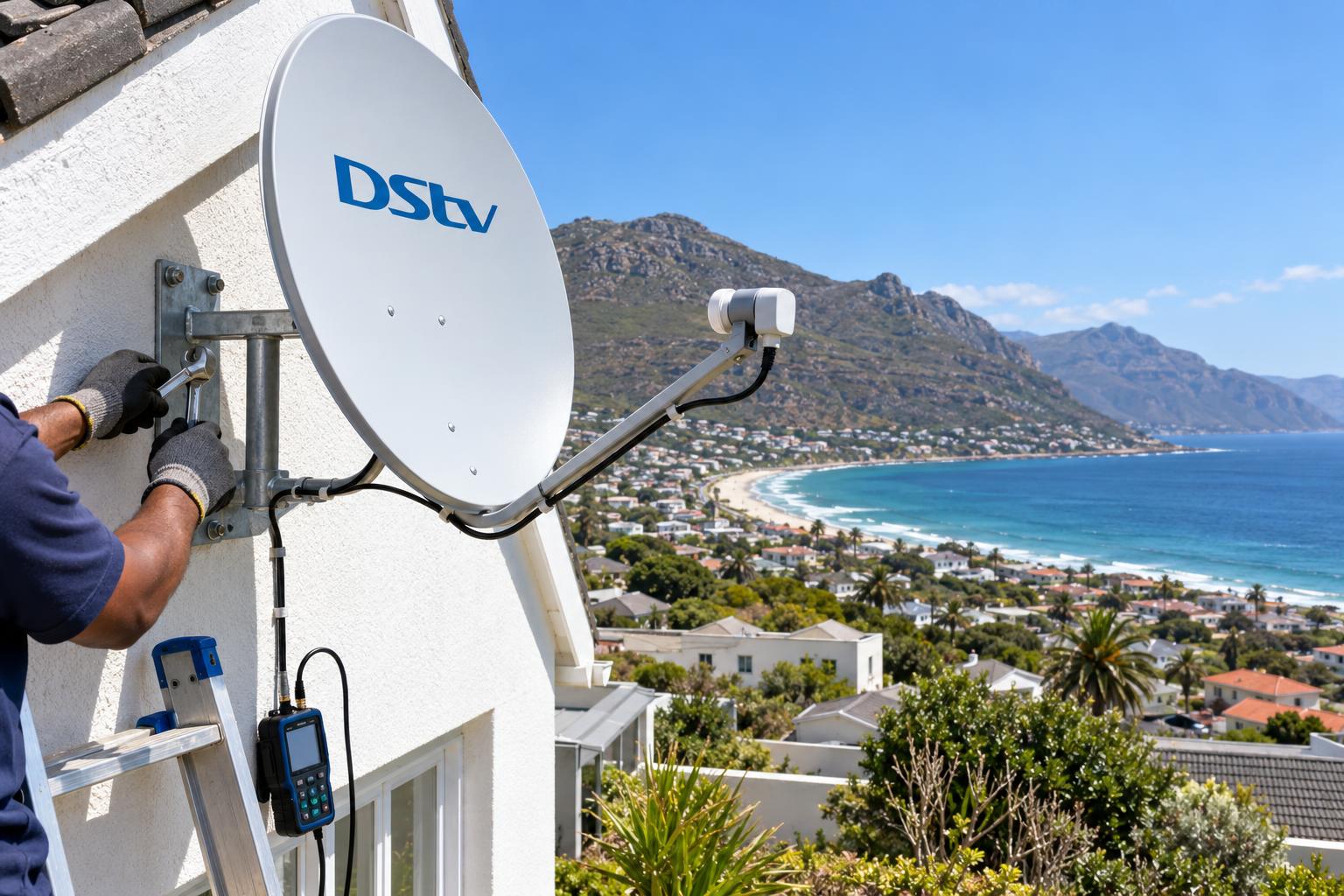
Quick answer: The southeaster rarely breaks a dish. It shakes a loose or rusty bracket until the dish creeps a fraction of a degree off the satellite, and that is enough to lose signal. Proper DStv dish alignment uses a signal meter to peak the quality reading, then locks the dish on a solid, rust-proof mount. Done right, it should hold through a whole Fish Hoek summer.
Every summer our phones start ringing the same week the southeaster arrives. People ask about DStv dish alignment Fish Hoek wide because the picture freezes, breaks into blocks or shows "no signal" each time the wind picks up. Most of them believe something about their dish that is not quite true. This guide clears up the common myths, gives you the plain facts, and ends with a checklist you can use before the next big blow.
DStv dish alignment myths we hear every summer
Wind and satellite signal cause a lot of confusion. Here are the myths we hear most, on roofs from Clovelly to Glencairn.
Myth 1: "The storm knocked out the satellite"
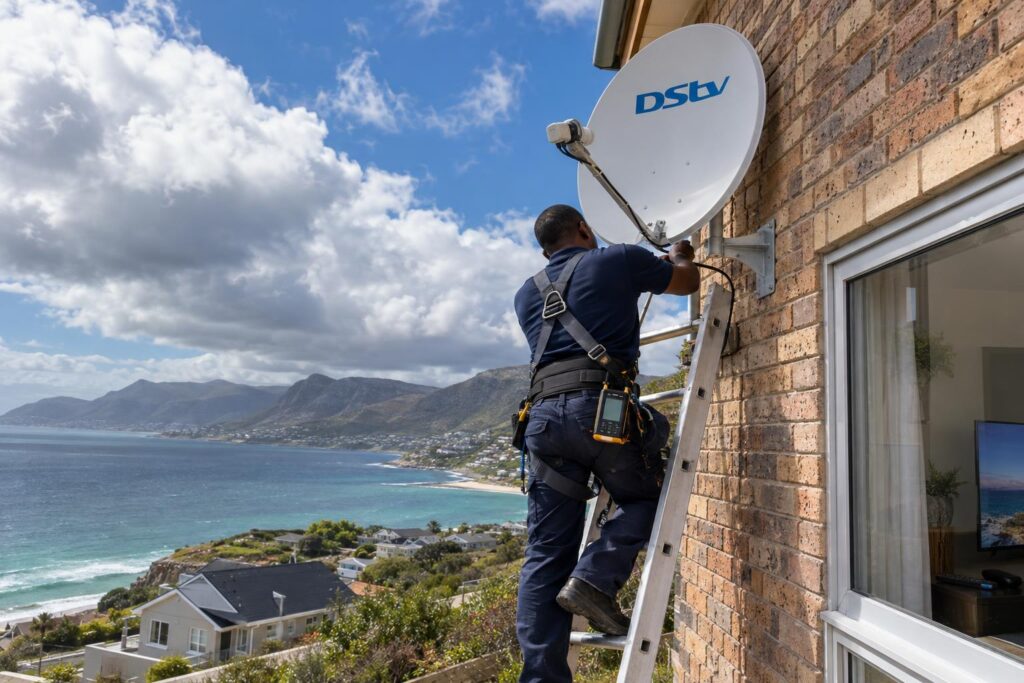
The satellite is fine. It sits far above the equator and does not feel our weather. What moves is the dish on your wall.
If your neighbour's picture is perfect and yours is not, the problem is almost always at your house.
Myth 2: "It is only the wind, it will come right"
Heavy rain can cut signal for a short time, and it does come back. Wind is different. Once a dish has shifted, it stays shifted.
The picture may return when the wind drops, then fail again at the next gust. That stop-start pattern is a classic sign of a loose dish.
Myth 3: "A bigger dish will fix it"
A bigger dish catches more wind. On a loose bracket, it simply moves more. The fix is a solid mount and accurate alignment, not more steel in the air.
We only recommend a dish change when the old one is damaged or rusted through. That is part of any good DStv installation in Fish Hoek, and we always explain why before we change anything.
Myth 4: "You can line it up by watching the TV"
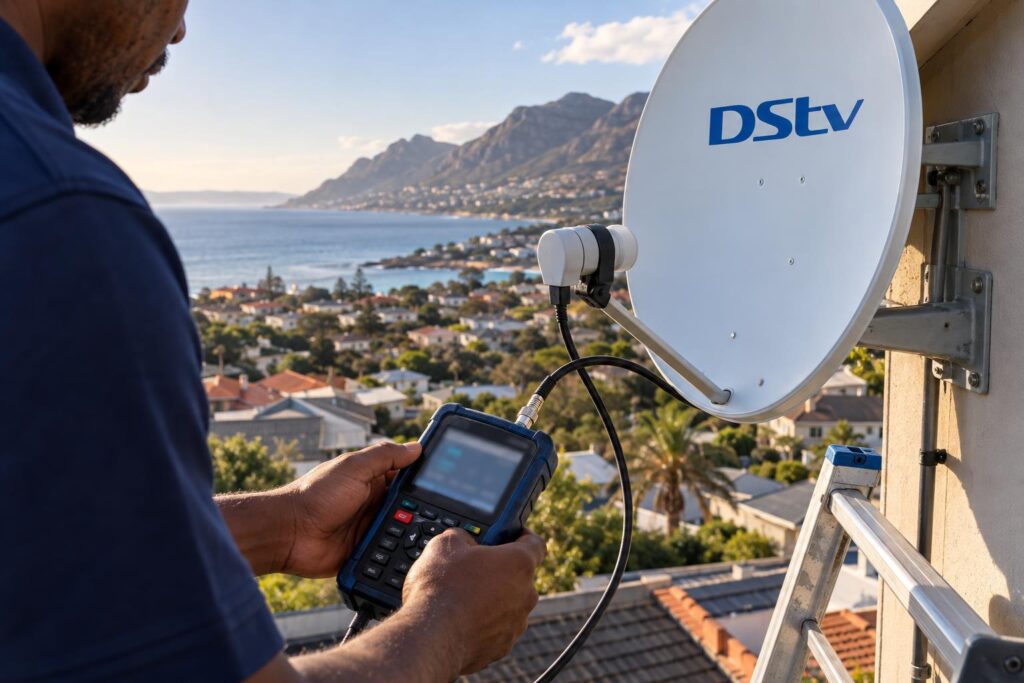
The TV can show a picture while the dish is still slightly off. That dish works on a calm day and fails in the first strong gust. Accurate DStv dish alignment needs a proper signal meter.
The facts: how the southeaster really moves a dish
A satellite dish has to point at one tiny spot in the sky. Being off by a fraction of a degree is enough to drop your signal quality. Here is what actually happens to your DStv dish alignment on a windy day.
The bracket moves, not the dish
Most dishes we fix are not bent. The wind pushes on the dish face thousands of times a day. Over weeks, that slowly works loose the bolts, rawl plugs or a thin fascia board behind the bracket.
- Bolts that were never fully tightened start to turn.
- Plugs in soft plaster or old brick work loose.
- Rusty brackets bend a little more with every strong gust.
- Dishes fixed to wooden fascia boards flex with the wood.
Our satellite dish alignment service deals with the mount first, because DStv dish alignment on a weak bracket only buys you a few weeks.
Signal strength and signal quality are not the same
Your decoder has a signal screen in its menu that shows two readings. Strength tells you a signal is arriving. Quality tells you how clean and usable it is.
A dish can show good strength with poor quality. That dish is close, but not locked on. During a DStv dish alignment, we peak the quality reading, then tighten everything while watching the meter so nothing slips.
The LNB matters too
The LNB is the small unit on the arm in front of the dish. If it is turned slightly on its holder, or its cover is cracked and letting in water, DStv dish alignment alone will not fix the picture. DStv gives a recommended retail price of R449 for the Smart LNB at the time of writing (October 2026), according to the official DStv Smart LNB FAQ. Our Smart LNB price guide explains when a Fish Hoek home actually needs a new one.
E48-32 after a windy day: weather or misalignment?
DStv lists E48-32 as a weather error, caused by stormy weather and rain. Its E48-32 help page suggests that once the weather is fine, you check the dish cables at the decoder and switch the decoder off at the wall for at least 10 seconds.
Here is how we tell whether you need DStv dish alignment or something else:
| What you notice | Most likely cause |
|---|---|
| No signal in heavy rain, back within the hour | Rain fade, normal |
| Signal drops in wind on a dry, sunny day | Loose or shifted dish |
| Picture breaks up more each month | Slow drift, rust or a tired LNB |
| No signal at all, even in calm weather | Dish knocked well off, or a cable fault |
| One room fine, another room dark | Cable or decoder link, not the dish |
If the error keeps coming back on clear days, it is not weather. Book our DStv signal repairs team and we will test at the dish and at the decoder to find where the signal is lost.
Picture dropping every time the wind blows?
We realign, re-secure and re-seal dishes across Fish Hoek and the Far South, often on the same day.
Call 079 754 5527WhatsApp usBook onlineWhat DStv dish alignment means for Fish Hoek homes
The South Peninsula is a tough place to keep a dish in line. The wind, the salt and the slopes all play a part, and each part of the valley has its own habits.
Valley homes in Fish Hoek, Sun Valley and Sunnydale
The southeaster funnels through the Fish Hoek valley towards Noordhoek. Homes on the valley floor and up towards Sun Valley and Sunnydale often take the wind side-on. Dishes on gable ends and high walls get the worst of it.
For DStv dish alignment in these spots, we look for a lower, more sheltered position that still has a clear view of the sky.
Sea-facing roofs from Kalk Bay to Simon's Town
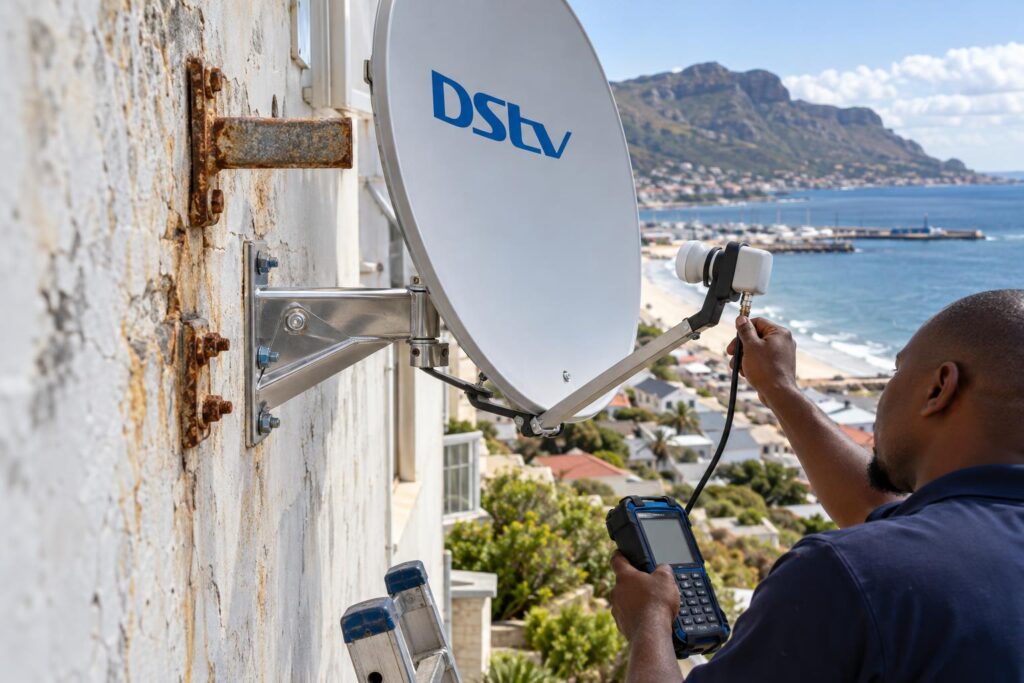
Along False Bay the problem is salt as much as wind. Salt spray rusts cheap brackets and bolts, and a rusty bracket loses its grip. That is why salt air corrosion and dish drift so often turn up on the same call-out in Kalk Bay, Glencairn and Simon's Town.
We use galvanised or stainless brackets with stainless fixings, and we seal every outdoor connector.
Holiday homes, complexes and farms
A holiday home can sit empty all winter while the dish slowly drifts. Nobody notices until the family arrives in December. Our holiday home DStv checklist covers what to test before the season starts.
In complexes, a shared dish may serve many units. If several flats lose signal at once, the body corporate's shared system is the place to start, not your own decoder. Smallholdings out on the Kommetjie road have their own challenge: long cable runs and dishes on poles in open, windy ground.
Local tip: If your dish needs realigning every summer, the alignment is not the real problem. The mount is. Ask your installer what the dish is bolted into and what the bracket is made of.
Can you do your own DStv dish alignment?
You can do the safe checks yourself. Fine DStv dish alignment is a different story. It means working on a ladder or roof, often in wind, while someone else watches the signal screen. We do not recommend it for most homeowners.
Before you call anyone, these steps are safe and often save a call-out:
- Wait for the rain to stop. If signal returns in dry weather, it may have been rain fade.
- Look at the dish from the ground. Does it point the same way as your neighbours' dishes?
- Check for anything new in the way, such as a tree branch, a new wall or a neighbour's extension.
- Check that the dish cable is firmly connected at the back of the decoder.
- Switch the decoder off at the wall, wait at least 10 seconds, then switch it on again.
- Open the signal screen in the decoder menu and note the strength and quality readings.
If the cable connections look doubtful, our guide to decoder cables and connections shows which plug goes where.
If the readings stay low, or your dish clearly points a different way to the rest of the street, it is time for a technician. Please do not climb onto a roof in a southeaster to move it by hand.
DStv dish alignment price in Fish Hoek
We keep DStv dish alignment prices simple and confirm the full amount before we start. These are our published starting prices. Parts are added only if they are needed.
| Job | From | What it covers |
|---|---|---|
| Repairs or call-out | R550 | Diagnostic visit, signal testing, dish realignment, LNB or cable repair |
| Basic installation | R800 | Single-view HD setup with dish, bracket and 15m RG6 cable |
| Smart LNB (part only) | R449 DStv recommended price | At the time of writing (October 2026), fitting is extra |
What changes the price:
- A rusted bracket or fixings that must be replaced.
- A cracked or water-filled LNB.
- Steep roofs, double storeys or pole mounts that need extra access.
- Moving the dish to a more sheltered spot with a longer cable run.
If the dish itself needs replacing, our article on what a proper dish install costs breaks down the parts.
For anything else, our Fish Hoek DStv installers can give you a clear figure once we know the job.
Your southeaster dish checklist
A good DStv dish alignment is only half the job. Here is what a dish that will survive a Far South summer should look like when we leave.
Key points for a wind-proof dish
- Aligned with a signal meter to peak quality, not just strength.
- Bolted into solid brick or a rafter, not a fascia board.
- Galvanised or stainless bracket and stainless bolts.
- LNB straight, tight and with an undamaged cover.
- Every outdoor connector sealed against salt and rain.
- Cable clipped down so it cannot flap in the wind.
- Signal reading checked again after all bolts are tight.
Check your dish from the ground each spring, before the southeaster season starts. A quick look for rust, a tilted dish or a loose cable is free and can save a call-out in the middle of a match.
Get your dish ready before the next southeaster
We cover Fish Hoek, Clovelly, Kalk Bay, Glencairn, Simon's Town, Noordhoek and the rest of the South Peninsula.
Call 079 754 5527WhatsApp usBook onlineDStv dish alignment Fish Hoek FAQs
Why does my DStv dish keep moving in the wind?
Usually the bracket or its fixings are loose, rusty or bolted into something weak like a fascia board. The wind works them loose a little at a time until the dish drifts off the satellite. Securing the mount properly stops it happening again.
How much does DStv dish alignment cost in Fish Hoek?
Our repairs and call-out work, which includes dish realignment, starts from R550. Parts such as a new bracket or LNB are added only if needed. We confirm the full price before we start.
Can I align my DStv dish myself?
You can do safe checks from the ground and at the decoder, such as checking cables and restarting the decoder. Fine alignment needs a signal meter and work at height, often in wind. For most homes it is safer and quicker to call a technician.
Is E48-32 always caused by bad weather?
DStv lists E48-32 as a weather error, and heavy rain can cut signal for a short time. If the error shows on dry, clear days, the usual causes are a shifted dish, a faulty LNB or a cable problem.
What is the difference between signal strength and signal quality?
Strength shows that a signal is reaching the decoder. Quality shows how clean and usable it is. A dish can show good strength with poor quality, which means it is close but not properly aligned.
How long does a DStv dish alignment take?
A straightforward realignment on a sound bracket is usually done in one short visit. It takes longer if the bracket, bolts or LNB need replacing, or if the dish must move to a better spot.